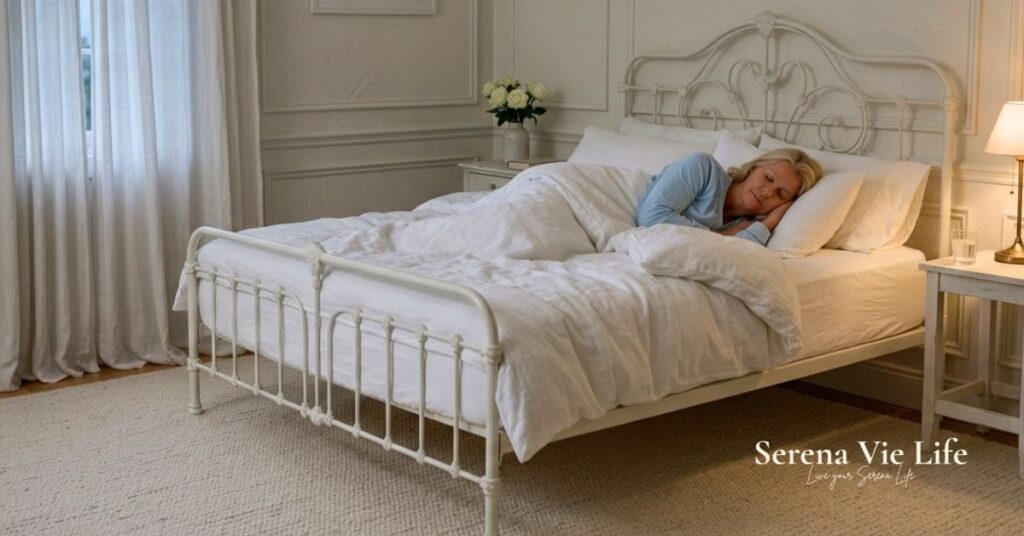

At some point after 50, many women start to feel the costs of a pace that used to seem sustainable. Not just tiredness — something deeper. A sense of living in fast-forward, reactive, never quite caught up, never fully present for anything. The term for the antidote is slow living, and it’s less a lifestyle trend than a genuine recalibration of priorities.
Slow living after 50 doesn’t mean doing less. It means doing things with more intention — fewer things, more fully. It means choosing what you give your attention to, rather than having it pulled in every direction by default.
What Slow Living Actually Means
The slow living movement grew out of the Slow Food movement started by Carlo Petrini in Italy in the 1980s — a response to the opening of a McDonald’s near the Spanish Steps in Rome. The core idea: speed and standardization have costs, and some of those costs only become visible when you slow down enough to notice them.
Applied to daily life after 50, slow living means:
- Fewer commitments, chosen with more care
- More time between activities — transition as rest, not dead time
- Meals eaten slowly, with attention, rather than consumed while doing something else
- Physical movement that you actually experience rather than check off
- Relationships maintained with depth rather than frequency
- The deliberate refusal of busyness as a status symbol
Why 50 Is the Natural Inflection Point for Slow Living After 50
Something shifts in the relationship with time after 50. Psychologists call this the “time perspective shift” — as perceived remaining life shortens, the things you choose to spend time on become less about achievement and more about meaning and connection. What felt like a satisfying busy life at 38 can feel hollow and draining at 55.
This isn’t a crisis. It’s information. Your values are clarifying, and they deserve to be acted on.
The practical challenge is that the structures of your life — work schedules, social obligations, family responsibilities, habits — were built around different priorities. Slow living after 50 requires deliberately restructuring those.
Where to Start: Four Entry Points
1. Protect one meal a day from distraction
No phone, no screen, no working through lunch. Eat. Taste the food. If you can, eat with someone you like. This single habit creates a daily anchor of presence that gradually changes your relationship with time and attention more broadly.
2. Build in transition time
Most stress accumulates in the spaces between things — rushing from one commitment to the next with no buffer. Start scheduling 15 minutes between activities that currently run back-to-back. Use that time to walk, sit, breathe, or do nothing at all. Over time, this changes your baseline nervous system state.
3. Practice single-tasking
Multitasking is a myth. What we call multitasking is rapid task-switching, which divides attention and reduces quality of engagement with everything. Choose one thing. Do it. Then the next. This is both more efficient and more satisfying than the scattered version.
4. Curate your inputs
The news cycle, social media, the ambient noise of digital life — these are all inputs you’ve agreed to receive by default. Slow living requires actively questioning which inputs serve you and turning off or limiting the ones that don’t. This isn’t about being uninformed. It’s about choosing the pace and format of information you consume.
Slow Living and Your Health
The health case for slowing down is substantial. Chronic time pressure — the persistent feeling of never having enough time — is associated with elevated cortisol, increased cardiovascular risk, impaired immune function, and accelerated cellular aging (measured by telomere length).
The practices of slow living — reduced pace, more time in nature, more meals cooked and eaten slowly, more sleep protected — each have independent evidence bases for reducing these markers of stress-driven aging. The combination is more powerful than any single intervention.
The Mediterranean lifestyle, which is one of the most studied examples of slow living in practice, is associated with the longest healthy life expectancy in the world. The longevity isn’t primarily dietary — it’s cultural. The pace, the relationships, the relationship with rest and food and community — these are the actual variables. Our look at the secrets of Italian women who age gracefully traces exactly how that culture translates into daily habits.
What You Might Have to Give Up
Slow living after 50 requires some honest conversations with yourself about what you’re willing to trade.
You may have to say no more often — to obligations that feel important but aren’t, to the social activities that fill your calendar without filling you, to the professional commitments you’ve continued out of habit rather than genuine engagement.
You may have to resist the cultural pressure to justify rest — to prove that the slower pace you’re choosing is earned, that you deserve the quiet. You do. Everyone does. The need to justify it is part of what you’re slowing down from.
The Paradox of Slow Living
Women who adopt slow living principles consistently report, somewhat paradoxically, that they accomplish more of what matters to them — not less. When attention is no longer fragmented across too many things, the things you do commit to get better quality engagement. The relationships deepen. The work improves. The experiences land more fully.
Slowing down isn’t falling behind. It’s choosing a different relationship with what “ahead” means — and who you’re racing toward it for.
If you’re also working on your self care routine, slow living principles make an excellent foundation: not more elaborate practices, but simpler ones done more fully.
This post contains affiliate links. If you purchase through them, I may earn a small commission at no extra cost to you.
Tools That Support a Slower, More Intentional Life
You don’t need to buy anything to live more slowly. But a few well-chosen objects can make certain practices easier to maintain — especially in the beginning, when habits need anchoring.
1. A Dedicated Journal for Reflection
A physical journal — not a notes app — creates a deliberate, offline space for thought. Five minutes of morning writing changes the quality of the day more reliably than almost any other single practice. The act of writing by hand slows thinking in a way that typing doesn’t, which is exactly the point.
Leuchtturm1917 Medium A5 Hardcover Notebook — the benchmark for quality notebooks, with numbered pages, a table of contents, and paper that doesn’t bleed. Available in multiple colors. A journal you keep on your nightstand or breakfast table becomes a physical anchor for the slow morning ritual you’re building.
2. An Evening Herbal Tea Ritual
A consistent evening tea ritual is one of the simplest, most accessible entry points to slow living. The act of preparing tea — boiling water, steeping, waiting — is inherently unhurried. Chamomile and lavender specifically support the nervous system transition from alert to rest, making this a ritual with both behavioral and biochemical effects.
Celestial Seasonings Sleepytime Herbal Tea — caffeine-free chamomile blend designed for evening. One of the most consistently purchased herbal teas on Amazon, with a long track record. Simple, affordable, and exactly the kind of small ritual that slow living is built on.
3. An Aromatherapy Diffuser for Evening Atmosphere
Scent is the fastest route to a physiological state change. A diffuser running lavender or bergamot in the 90 minutes before bed creates an olfactory cue that signals the day is ending — one your nervous system will begin to recognize over time. The ritual of setting it up is itself a slow, intentional act.
URPOWER 500ml Essential Oil Diffuser — quiet ultrasonic operation, adjustable mist, optional warm light setting. Runs for hours on a single fill. A practical aromatherapy tool that also functions as a subtle light source for dimming your environment in the evenings.
Sources:
Carstensen LL — “A long bright future: happiness, health, and financial security in an age of increased longevity” — 2009
Epel ES et al. — “Accelerated telomere shortening in response to life stress” — PNAS, 2004 — pubmed.ncbi.nlm.nih.gov
Harvard Health Publishing — “Stress management” — health.harvard.edu