
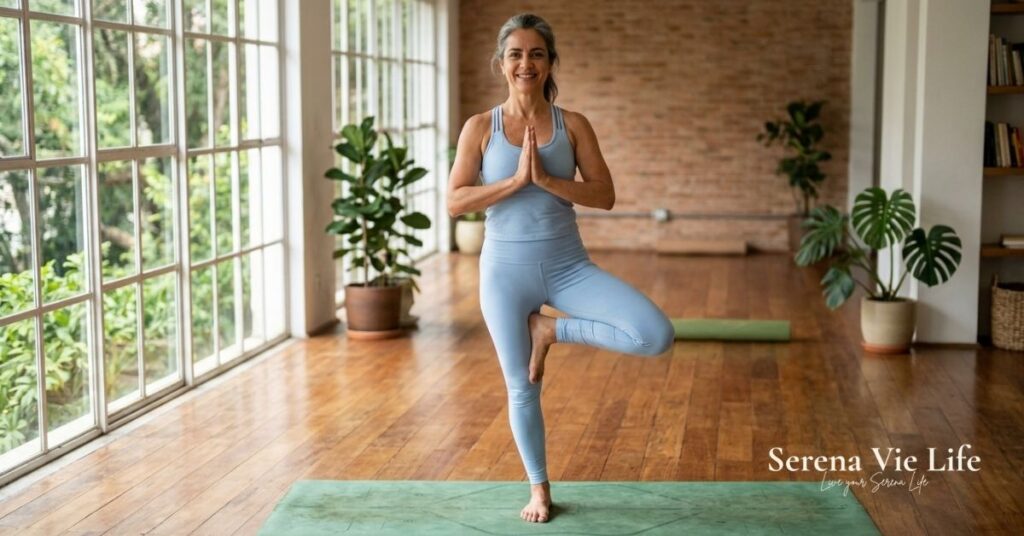
If the idea of starting yoga after 50 makes you picture a room full of 25-year-olds bending themselves into positions you stopped being able to do in your 30s — let go of that image. Yoga for women over 50 looks different, and in many ways, it’s more effective. Midlife brings a different kind of body awareness, more patience, and less ego about what a pose should look like. All of that makes you a better yoga student than you might expect. In fact, yoga for women over 50 tends to produce results faster than it does for younger practitioners, precisely because of that shift in how you inhabit your body.
The physical benefits of yoga after 50 are well-documented: improved balance (which directly reduces fall risk), better joint mobility, reduced back pain, lower cortisol levels, and measurably better sleep. A 2015 study in the journal Menopause found that women who practiced yoga regularly experienced significant reductions in hot flash frequency and severity — an unexpected but welcome bonus.
Here’s how to start, what styles suit a midlife body, and what to realistically expect in the first few months.
Why Yoga Is Especially Valuable After 50
After menopause, several physical changes make yoga particularly relevant:
- Bone density decline — weight-bearing yoga poses stimulate bone formation. Weight-bearing styles like Hatha and Vinyasa are especially beneficial for maintaining density
- Muscle loss (sarcopenia) — yoga builds functional strength in a low-impact way that protects joints while building the muscle that naturally declines after 50
- Balance deterioration — balance peaks in your 20s and declines steadily after 40. Yoga’s single-leg poses and proprioceptive challenges slow this decline significantly
- Stress and cortisol — yoga’s combination of breathwork and movement is one of the most studied interventions for lowering baseline cortisol and reducing anxiety in midlife women
- Sleep quality — restorative and yin yoga practiced in the evening reliably improves sleep onset and depth
Yoga for Women Over 50: The Best Styles to Start With
Hatha Yoga — the best starting point
Hatha classes move at a deliberate pace and hold poses long enough that you can understand what you’re doing and why. There’s no flow between poses, which means more time to modify and less chance of injury. If you’ve never practiced yoga, Hatha is where to begin.
Restorative Yoga — for stress and sleep
Restorative yoga uses props (blocks, bolsters, blankets) to support the body in deeply relaxed positions held for 5–10 minutes each. It’s not about flexibility — it’s about activating the parasympathetic nervous system. Women with high stress, sleep issues, or chronic tension often find restorative yoga transformative within the first few sessions.
Chair Yoga — for those with mobility limitations
All the benefits of yoga, performed seated or using a chair for support. Excellent for women with knee, hip, or balance concerns. Often taught at community centers and also available as video programs. Don’t dismiss it — chair yoga can be surprisingly challenging and deeply therapeutic.
Yin Yoga — for joints and fascia
Yin targets connective tissue (fascia, ligaments, tendons) rather than muscle. Poses are held for 3–5 minutes in a relaxed state. After 50, when connective tissue naturally becomes less elastic, yin yoga is one of the most effective ways to maintain the mobility that keeps you moving freely.
Avoid (at first): Hot Yoga, Power Yoga, Ashtanga
These styles demand strength, flexibility, and cardiovascular fitness that takes time to build. Hot yoga adds dehydration risk and cardiovascular stress that’s inappropriate for beginners at any age. Start gentle, build slowly. You can always add intensity later.
How to Start: A Practical First Month of Yoga for Women Over 50
Week 1–2: Learn the foundations
Focus on three poses: Child’s Pose, Cat-Cow, and Mountain Pose. These establish the basics of breath-movement connection, spinal flexibility, and body alignment. Do them for 10 minutes every morning. Watch a beginner video if you’re unsure of the form — alignment matters more in yoga than in almost any other exercise.
Week 3–4: Add standing poses
Introduce Warrior I, Warrior II, and Tree Pose. Use a wall or chair for balance support without embarrassment — every experienced yogi uses props. These three poses build leg strength, hip flexibility, and balance simultaneously.
Beyond month one
Find a local Hatha or restorative class, or subscribe to a beginner online yoga platform. Consistency matters more than frequency — three 20-minute sessions per week will produce more benefit than one 90-minute class once a week.
This post contains affiliate links. If you purchase through them, I may earn a small commission at no extra cost to you.
Yoga Equipment Worth Having
You don’t need much to start. But the right tools make the practice more comfortable, safer, and easier to stick with — especially when joints and flexibility need extra consideration.
1. A Thick, Non-Slip Yoga Mat
The standard 3mm yoga mat is too thin for women with sensitive knees, wrists, or ankles. A 6mm or thicker mat provides meaningful cushioning without making balance poses unstable. Non-slip texture is non-negotiable — sliding mid-pose is both dangerous and discouraging.
Gaiam Premium Print Yoga Mat 6mm — extra thick, non-slip surface, available in multiple colors. Lightweight with a carry strap. One of the most trusted yoga mat brands with consistently high ratings from beginners and experienced practitioners alike.
2. Yoga Blocks + Strap Set
Blocks bring the floor closer to you when your flexibility doesn’t yet allow a full reach. Straps extend your reach for forward folds and hip openers. These two props make the difference between straining into a pose and actually benefiting from it. Every beginner — regardless of age — should use them.
Syntus Yoga Block and Strap Set — includes two foam blocks and an 8-foot D-ring strap. Soft, non-slip surface on blocks. Everything a beginner needs in one affordable set.
3. A Practical Beginner’s Yoga Book
Having a visual reference at home removes the barrier of always needing to stream something. A good yoga book shows pose variations, modifications, and sequences in a format you can return to without a screen.
The Women’s Health Big Book of Yoga — comprehensive guide with illustrated poses, modifications for different fitness levels, and targeted sequences. Written specifically for women’s bodies and goals. A genuinely useful reference that doesn’t collect dust.
4. Chair Yoga for Days When Your Body Needs It
Some mornings, the floor isn’t where you want to be. A chair yoga program gives you a complete, therapeutic yoga practice on the days when joints are stiff, energy is low, or balance feels off. It’s not a lesser yoga — it’s a smarter one for those particular days.
10-Minute Chair Yoga for Seniors Over 60 — 28-day program with over 100 illustrated poses, designed for flexibility and joint support. Accessible, no-floor-required yoga that works for women at every fitness level.
Frequently Asked Questions About Yoga for Women Over 50
Is yoga safe if I have osteoporosis?
Many yoga poses are safe and beneficial for osteoporosis — they build bone-stimulating muscular tension without impact. However, certain forward folds and spinal flexion poses carry fracture risk and should be avoided or modified. Tell your yoga teacher about your diagnosis; a good teacher will offer appropriate modifications.
What if I’m not flexible at all?
Flexibility is not a prerequisite for yoga — it’s a result of it. Everyone feels stiff at the beginning. Props (blocks and straps) exist precisely for this reason. The women who benefit most from yoga are often those who start with the least flexibility.
How soon will I see results?
Most beginners notice improved morning stiffness and better sleep within 2–3 weeks of regular practice. Balance improvements are typically noticeable within 4–6 weeks. Flexibility takes longer — 8–12 weeks of consistent practice to see meaningful change.
Should I practice yoga in the morning or evening?
Morning yoga — even 10–15 minutes — sets a calmer tone for the day and helps lubricate stiff joints. Evening yoga, especially restorative or yin, supports sleep. If you can only do one, choose the time you’ll actually do it consistently.
Can yoga replace other forms of exercise?
Yoga covers flexibility, balance, and functional strength well, but doesn’t provide the cardiovascular or high-load bone-building stimulus that walking, swimming, or weight training do. Think of yoga as an essential layer of your movement routine — complementary to, not a replacement for, other forms of activity. A good morning movement habit can include a short yoga practice alongside a brisk walk.
Your Body Is Ready. Start There.
The best time to start yoga was twenty years ago. The second best time is this week — with a mat, a couple of blocks, and ten minutes you’re willing to spend getting to know your body again. It doesn’t have to look like what you see on Instagram. It just has to be consistent.
Start with Hatha or chair yoga. Use props liberally. Go slowly. And give it four weeks before deciding whether it’s working.
Sources:
Cramer H et al. — “Yoga for menopausal symptoms — a systematic review” — Maturitas, 2012 — pubmed.ncbi.nlm.nih.gov
Wayne PM et al. — “Impact of Tai Chi and Yoga on bone health in postmenopausal women” — Osteoporosis International, 2012 — pubmed.ncbi.nlm.nih.gov
Harvard Health Publishing — “Yoga — Benefits Beyond the Mat” — health.harvard.edu