
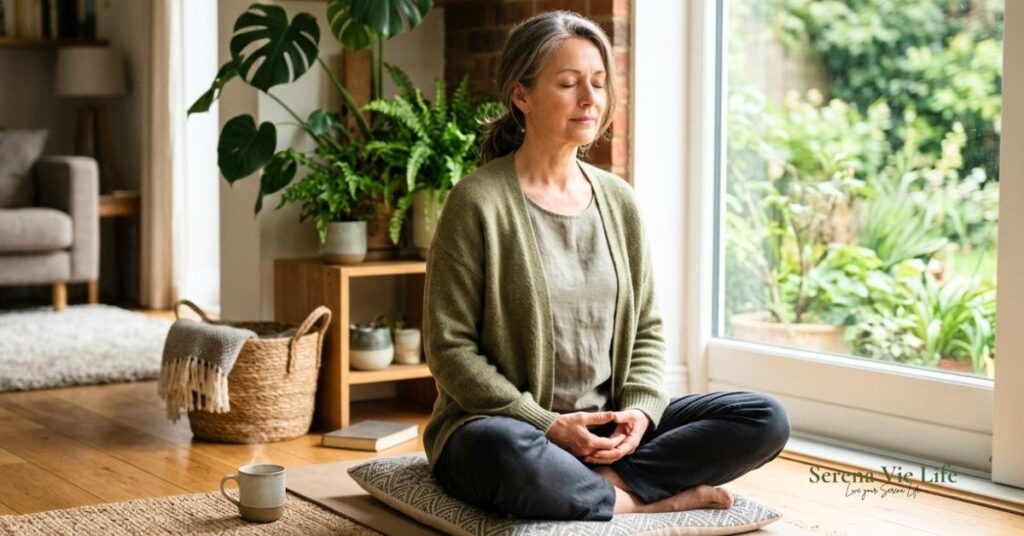
You’ve probably heard that meditation helps with stress. Maybe you’ve tried it once or twice, opened an app, sat there for three minutes feeling like your mind was broken, and quietly closed it. That’s most people’s experience — and it doesn’t mean meditation isn’t for you. It means you weren’t taught how it actually works.
Here’s what’s worth knowing: meditation for anxiety and low mood has a substantial body of clinical research behind it — not the wellness-magazine kind, but peer-reviewed trials published in journals indexed by the NIH. And the effects are particularly meaningful for women in their 40s and 50s, whose anxiety and mood shifts often have hormonal roots that no amount of positive thinking addresses on its own.
This isn’t about emptying your mind or achieving inner peace. It’s about changing the relationship your nervous system has with stress — and that’s something anyone can learn, even if you’ve failed at it before.
Why Anxiety and Low Mood Often Travel Together After 45
If you’ve noticed that your anxiety and low mood seem to arrive as a pair — one bad day bleeds into another, worry keeps you up at night, and the flatness that follows feels like it has no clear cause — that’s not a coincidence.
Estrogen plays a direct role in how the brain regulates both serotonin (the mood stabilizer) and GABA (the natural calming chemical). As estrogen fluctuates during perimenopause and declines after menopause, both systems are affected simultaneously. The result is a nervous system that’s more reactive to stress and slower to recover from it.
Add disrupted sleep — itself a major driver of anxiety — plus the very real psychological weight of midlife transitions, and the anxiety-low mood loop becomes self-reinforcing. Understanding this matters because you’re not managing two separate problems. You’re addressing one underlying pattern of dysregulation. And meditation for anxiety and low mood works precisely at that level.
If you’re trying to understand the full picture of what drives low mood during this stage of life, our article on feeling sad for no reason after 45 covers the six most common biological causes in detail.
What Meditation Actually Does to Your Nervous System
Meditation isn’t relaxation, though relaxation often follows. What it actually does is train the prefrontal cortex — the part of the brain responsible for rational thought, perspective, and emotional regulation — to exert more influence over the amygdala, which is the brain’s threat-detection alarm.
When anxiety spikes, the amygdala is running the show. Meditation, practiced consistently, literally changes the structural relationship between these regions. Brain imaging studies show that regular meditators have a smaller, less reactive amygdala and stronger prefrontal cortex activity. This isn’t metaphorical — it shows up on scans.
For mood, the mechanism is slightly different. Meditation increases activity in the left prefrontal cortex, which is associated with positive emotional states, and decreases the rumination — the looping, self-critical thoughts — that underlies a great deal of low mood.
A 2022 systematic review and meta-analysis published in Frontiers in Public Health, focusing specifically on menopausal women, found that mindfulness-based interventions significantly reduced anxiety, depression, and perceived stress. Another clinical study published in PubMed found that perimenopausal women who underwent mindfulness meditation training showed significant improvements in both anxiety and depression scores compared to controls.
These aren’t soft findings. The evidence is solid enough that several major medical centers now include mindfulness-based stress reduction (MBSR) as a standard recommendation for anxiety management.
How to Start — Even If You’ve Tried and Failed Before
Most people “fail” at meditation because they misunderstand the goal. The goal is not to have a quiet mind. The mind will wander — that’s what minds do. The practice is noticing that it has wandered and bringing it back. That noticing? That’s the rep. That’s where the benefit comes from. A session where your mind wandered forty times and you brought it back forty times is a good session.
A few things that actually help beginners:
Start with two minutes, not twenty. Two minutes of consistent daily practice beats twenty minutes once a week. Duration matters far less than regularity in the early weeks. Once the habit is established, you’ll naturally want to extend it.
Anchor to something you already do. Immediately after your morning coffee, before you open your phone — that’s a natural slot. Meditation works best when it attaches to an existing behavior, not as a separate “should” on your list.
Sit comfortably, not perfectly. You don’t need a cushion, a special room, or to sit cross-legged. A chair, feet flat on the floor, spine reasonably upright. That’s enough.
Eyes closed or soft gaze downward. Either works. Some people find a soft gaze easier when the mind is very busy.
Let go of the idea that you’re bad at this. There is no one who is naturally good at meditation. Everyone’s mind wanders. The difference between a beginner and an experienced meditator is simply how quickly they notice.
The Most Effective Practices for Anxiety and Low Mood
Not all meditation is the same. Different techniques work through different mechanisms, and knowing which ones are best supported for anxiety and mood helps you choose where to start.
Breath-focused meditation
This is the most studied and the best starting point. You focus attention on the physical sensation of breathing — the rise and fall of the chest or belly, the feeling of air at the nostrils. When the mind wanders (and it will), you notice, and return. That’s the entire practice.
For anxiety specifically, slow breathing during meditation also activates the parasympathetic nervous system directly, lowering heart rate and cortisol. Even before the long-term structural benefits develop, there’s an immediate physiological calming effect.
Body scan
You move attention slowly through each part of the body, noticing sensations without trying to change them. This is particularly effective for anxiety because anxiety lives in the body — the tight chest, the shallow breathing, the clenched jaw — and body scan teaches you to observe those sensations rather than react to them.
A 20-minute body scan before sleep is one of the most effective non-pharmaceutical tools for both sleep and next-day mood. The Mayo Clinic notes that mindfulness practices including body scan have shown meaningful benefits for menopausal symptoms including mood and sleep.
Loving-kindness meditation (metta)
You silently direct phrases of goodwill — toward yourself first, then others. Something like: May I be well. May I be at peace. May I be free from suffering. This sounds simple to the point of silly. The research disagrees.
Loving-kindness practice has demonstrated significant effects on depression, self-criticism, and emotional resilience. It’s particularly useful for the kind of low mood that comes with harsh self-judgment — the sense that you should be doing better, feeling better, being better. Many women in midlife carry a backlog of this.
Mindfulness of thoughts
Rather than trying to stop anxious thoughts, you practice observing them as mental events — like clouds passing through the sky — without following their storyline. You label them lightly: worry, planning, memory, judgment. This metacognitive shift — watching thoughts rather than being pulled into them — is at the core of mindfulness-based cognitive therapy (MBCT), which has strong evidence for preventing depressive relapse.
How to Build a Habit That Actually Sticks
Research consistently shows that the benefits of meditation for anxiety and low mood are dose-dependent: more consistent practice produces stronger effects. But consistency, not duration, is the variable that matters most in the first three months.
Same time, same place. Context cues are powerful. When you meditate in the same chair, at the same time, your brain starts associating that context with the practice and settling becomes easier.
Track streaks, not quality. Don’t evaluate whether today’s session was good or bad. Just mark that it happened. A two-minute session where you felt distracted counts.
Don’t try to solve the anxiety during meditation. That’s rumination wearing a wellness costume. If a thought comes up repeatedly, note it — planning — and return to the breath.
Use guided audio for the first 60 days. A voice gives the wandering mind something to return to. Apps like Insight Timer (free), Calm, or Headspace all have solid beginner tracks. Once the structure is internalized, you can practice in silence.
For other evidence-backed approaches to lifting mood during this stage of life, our article on how to improve your mood naturally after 45 covers the full picture — from sleep to targeted supplements.
Frequently Asked Questions
How long does it take for meditation to help with anxiety?
Most people notice some immediate effect — a sense of calm after the session — within the first week. Measurable changes in baseline anxiety tend to appear after four to eight weeks of daily practice.
Do I need to meditate every day?
Daily practice produces the strongest results, but five or six days a week is effectively the same. The sessions that feel hardest are often the most useful — don’t skip them.
Can meditation replace medication or therapy for anxiety?
No — and it’s not designed to. Meditation is a tool for managing everyday anxiety and mild to moderate low mood. For clinical anxiety or depression, professional treatment is necessary. Meditation works well alongside therapy or medication, not instead of it.
What if I fall asleep during meditation?
It happens, especially with body scans. Try meditating in a seated position rather than lying down, or switch to morning practice when you’re more alert.
Is there a type of meditation that’s better for anxiety specifically?
Breath-focused meditation and body scan have the strongest direct evidence for anxiety. Loving-kindness has the strongest evidence for low mood and self-criticism. Most people find it useful to rotate between them — breath in the morning, body scan before bed.
My mind is too busy to meditate. Is that normal?
Yes. A busy mind is not an obstacle to meditation for anxiety and low mood — it is the condition meditation is designed for. Start with two minutes and trust that the noticing is the practice.
The Simplest Place to Start
Tomorrow morning, before you open your phone, sit somewhere comfortable. Set a timer for five minutes. Close your eyes. Feel your feet on the floor. Notice the sensation of breathing — not controlling it, just noticing it. When you notice your mind has wandered, bring it back. Do that for five minutes.
That’s it. That’s the whole practice at first. It will feel like nothing. Do it again the next day. And the next. The benefit doesn’t arrive in a single session — it accumulates, quietly and reliably, the way most real things do.
Sources: National Center for Complementary and Integrative Health — Meditation and Mindfulness: What You Need to Know (nccih.nih.gov) · Shan Liu et al. — The effects of mindfulness-based interventions on anxiety, depression, stress, and mindfulness in menopausal women: a systematic review and meta-analysis, Frontiers in Public Health (2022, PMC9869042) · Chinese clinical study — Effect of mindfulness meditation training on anxiety, depression and sleep quality in perimenopausal women, PubMed (2019, PMID 31511223) · Mayo Clinic News Network — Mindfulness may ease menopausal symptoms (newsnetwork.mayoclinic.org)