
There’s a French word — flâner — that translates loosely as wandering without purpose, letting yourself drift through time without agenda. The French have always made more room for this kind of unhurried existence than most cultures, and it shows up in unexpected places. Including sleep.
Research confirms what travelers to France have long suspected: why French women sleep better has measurable data behind it. French women, on average, sleep longer and report better sleep quality than their American counterparts. A cross-national study by the National Sleep Foundation found that French adults average 7.13 hours of sleep per night — more than Americans (6.9 hours), and significantly more in terms of reported satisfaction with sleep quality. The gap seems small. The causes are instructive.
The question of why French women sleep better isn’t answered by a single habit. It’s answered by a cluster of small cultural practices around how evenings are structured, how meals are eaten, how the transition from day to night is managed — practices that most of us used to have versions of, and gradually abandoned.
The Evening Isn’t Productive Time
This might be the most fundamental difference. In American culture, the evening is often treated as extra work time, errand-catching-up time, or passive consumption time (screens). Productivity doesn’t fully stop until you physically can’t keep your eyes open.
French culture — at least as a general tendency — treats the evening differently. Dinner is a real meal, eaten slowly, often with other people. The hours after dinner are for conversation, reading, unhurried walks, low-stimulation activities. There isn’t a cultural imperative to maximize the evening the way there is in the US.
This matters biologically. The nervous system needs 1–2 hours to begin transitioning from active to rest mode. Filling that window with screens, work, or high-stimulation input suppresses melatonin and delays sleep onset. Filling it with dinner, conversation, and quiet winds the body down naturally.
The French Approach to Dinner and Sleep
French dinner culture has several features that are incidentally excellent for sleep:
- Dinner is eaten late, but not heavy. A 7:30 or 8:00 p.m. dinner of moderate portions gives the digestive system time to partially complete before sleep, reducing the reflux and discomfort that disrupt sleep quality in many American women over 50.
- Wine with dinner, not before it. A small glass of wine with food metabolizes differently than wine on an empty stomach. Blood alcohol levels are lower and more stable during sleep, meaning less disruption to sleep architecture in the later hours of the night.
- No late snacking. The kitchen closes after dinner. The 10 p.m. bowl of cereal, the post-news chips — these raise blood sugar right before sleep, triggering an insulin response that disrupts the natural drop in core body temperature needed for deep sleep.
Bedroom as Sanctuary, Not Extension of Life
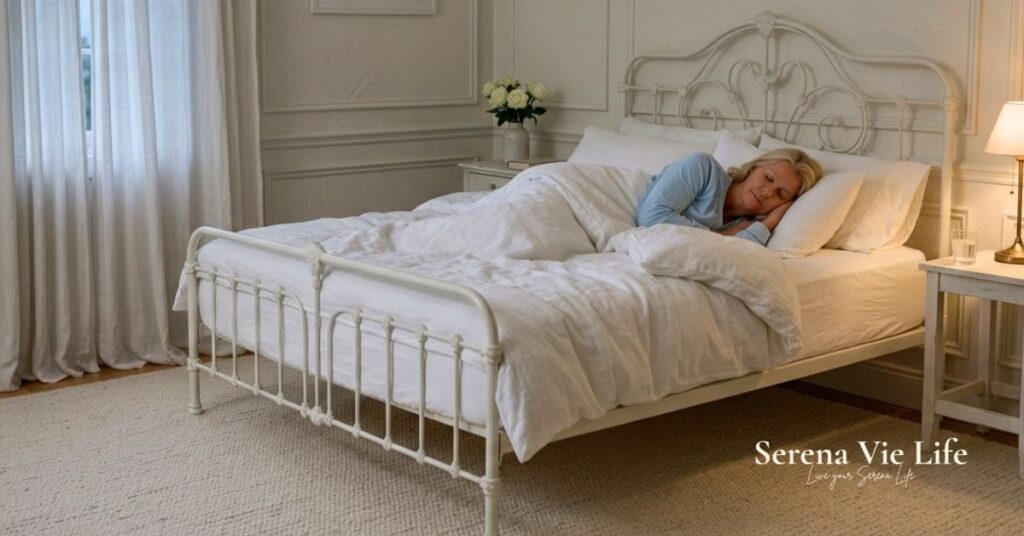
French interior culture tends toward the bedroom as a private, adult space — calm, dark, uncluttered, not also a home office or a second living room. Screens are typically not in the bedroom. Work materials are not in the bedroom. The bedroom is associated, neurologically, only with sleep and intimacy.
This isn’t decorative preference. It’s behavioral conditioning. Your brain is extremely good at associating places with states. If you’ve spent years working, scrolling, watching television, and eating in bed, your brain no longer recognizes the bed as a sleep cue. The French habit of keeping the bedroom reserved — actually reserved — trains the brain in the other direction.
The Night Ritual: Slow, Sensory, Predictable
French women tend to have consistent evening skincare rituals — not complex ones, but reliable ones. Cleanse, apply serum or facial oil, moisturize. The routine takes five to ten minutes and serves double duty: caring for skin that needs extra hydration after 50, and providing a reliable sensory cue that the day is ending.
The olfactory element matters more than it might seem. Familiar scents (a particular soap, a specific night cream, a drop of lavender on the pillow) trigger the limbic system’s association with rest. These aren’t superstitions — they’re conditioned neurological responses that build over time with consistency.
Similarly, French women tend to read before bed rather than scroll. Reading lowers cortisol and heart rate. Six minutes of reading has been shown to reduce muscle tension by 68% in research from the University of Sussex — more than listening to music or taking a walk. Screens do the opposite: the blue light suppresses melatonin and the content (news, social comparison, email) keeps the threat-detection system activated.
Magnesium and the French Pharmacy Culture
France has a strong pharmacy culture — the French pharmacist is a trusted first stop for health questions, and the French spend more on pharmacy products than almost any other European nation. Magnesium supplementation for sleep and stress is common and widely recommended by French pharmacists for women in their 40s and beyond.
This aligns well with what the science says: magnesium deficiency is extremely common in postmenopausal women and is directly linked to sleep disruption, muscle tension, and anxiety. Magnesium glycinate or bisglycinate, taken in the evening, supports both sleep quality and the muscle relaxation that makes falling back asleep after nighttime waking easier — one of the most common complaints of women over 50 who wake during the night.
Why French Women Sleep Better: Three Changes Worth Making Tonight
You don’t need to restructure your entire evening. Three changes, applied consistently, will make a measurable difference:
- Create a kitchen-closes time — ideally 90 minutes before bed. No food, no alcohol after that point.
- Replace 30 minutes of evening screen time with reading or a slow ritual — skincare, herbal tea, journaling, whatever feels natural.
- Make your bedroom only a sleep room — charge your phone in another room, remove any work materials, darken the room properly.
If you’ve been struggling with finding natural sleep aids that work, the behavioral changes may matter more than any supplement. But a quality magnesium product used alongside an improved evening routine addresses both the structural and biochemical sides of sleep disruption after 50. If night sweats are part of what’s waking you up, cooling bedding designed for temperature regulation targets that trigger directly — see our full guide to the best pillows and bedding for night sweats.
Why French Women Sleep Better: The Role of the Bedroom Environment
Before French women do anything else for sleep, they get their bedroom right. This sounds obvious, but in practice most of us have bedrooms that work against sleep — screens, ambient light from charging devices, temperatures that are too warm, pillows that have needed replacing for years. French women treat the bedroom as a dedicated sleep environment, not a multipurpose room.
Darkness is non-negotiable. Heavy curtains or quality blackout blinds are a standard fixture in French bedrooms, not a special purchase. The logic is simple: darkness signals to the brain that sleep is appropriate. Any light — including the glow from a phone charger or a streetlight through thin curtains — can interfere with melatonin production and delay the onset of deep sleep.
Temperature follows. The ideal sleep temperature is cooler than most people keep their bedrooms: around 65–68°F (18–20°C). French homes tend to run cooler in general, which may be part of why sleep quality surveys consistently rank French adults higher than Americans. If you can’t control your room temperature, a lighter duvet or a fan can approximate the same effect.
The third element is silence — or near silence. French women are protective of their evening quiet in a way that Americans often aren’t. Dinner conversation winds down rather than escalating. Television, if watched at all, stops well before bed. There’s a gradual quieting of stimulation in the hours before sleep that the bedroom environment then reinforces.
None of this requires expensive renovation. Good curtains, a cooler thermostat setting, and leaving your phone to charge in another room address all three variables. These changes alone — without any supplement or technique — have been shown in sleep research to meaningfully improve sleep onset time and the proportion of restorative deep sleep. Understanding why French women sleep better often comes down to these unglamorous environmental decisions, made consistently, every night.
Frequently Asked Questions
Do French women really sleep significantly better?
Cross-national sleep data consistently shows France among the higher-scoring countries for sleep duration and reported quality. Cultural practices — particularly around evenings and meals — are thought to be a significant contributing factor, though individual variation is enormous.
What if I genuinely can’t stop evening screen use?
Use blue-light filtering glasses in the evening and switch your devices to night mode after 8 p.m. It’s not as effective as stopping altogether, but it reduces the melatonin suppression significantly. The content matters too — news and social media are more activating than a slow documentary or a film you’ve seen before.
Is late dinner actually better for sleep?
Not inherently — the content and size of the meal matter more than the timing. A light dinner at 8 p.m. is better for sleep than a heavy dinner at 6 p.m. The French tendency toward smaller evening portions with moderate wine is more relevant than the clock time.
How long does it take to reset poor sleep habits?
Sleep hygiene changes typically begin showing results within two to three weeks of consistent application. The brain’s behavioral associations are slower to change than the physiological effects — which is why consistency over several weeks matters more than intensity of any single good night.
Products That Support the French Approach to Sleep
This post contains affiliate links. If you purchase through these links, I may earn a small commission at no extra cost to you. I only recommend products I genuinely believe in.
If you want to bring one or two of these habits into your bedroom tonight, these are the products worth starting with.
1. Doctor’s Best High Absorption Magnesium Glycinate
The magnesium that French pharmacists are most likely to recommend for sleep is glycinate — the form that absorbs most efficiently and doesn’t cause digestive discomfort. Doctor’s Best is one of the most trusted brands in this category, with chelated magnesium that’s consistently well-reviewed for sleep and relaxation support in women over 50.
2. Cozynight Weighted Lavender Eye Mask
A sleep mask does two things the French bedroom already prioritizes: blocks light completely, and when filled with lavender, delivers a gentle scent that signals rest to your nervous system. The weighted version adds mild pressure that many women find calming — similar in effect to being under a warm, heavy blanket.
3. Nature Creation Lavender Aromatherapy Eye Pillow
Filled with flaxseed and dried lavender flowers, this eye pillow can be used warm or cool. The gentle weight and lavender scent make it a simple sensory wind-down tool — placed over your eyes for ten minutes before bed, it’s the kind of quiet ritual that why French women sleep better ultimately comes down to: small, intentional, repeated every night.
Sleep as a Practice, Not a Destination
What French culture gets right about sleep isn’t a single trick or supplement. It’s treating sleep as something that’s prepared for, protected, and given proper conditions — rather than something that should just happen after you run out of day.
The habits described here aren’t exotic. They’re closer to what most people did before screens became the dominant feature of evening life. Recovering them doesn’t require becoming French. It just requires deciding that sleep is worth the 30 minutes of deliberate attention it takes to do it well.
Sources:National Sleep Foundation — “2013 International Bedroom Poll” — sleepfoundation.org
Bhui K et al. — “Reading as a way to manage stress” — University of Sussex, 2009
Harvard Health Publishing — “Blue light has a dark side” — health.harvard.edu