
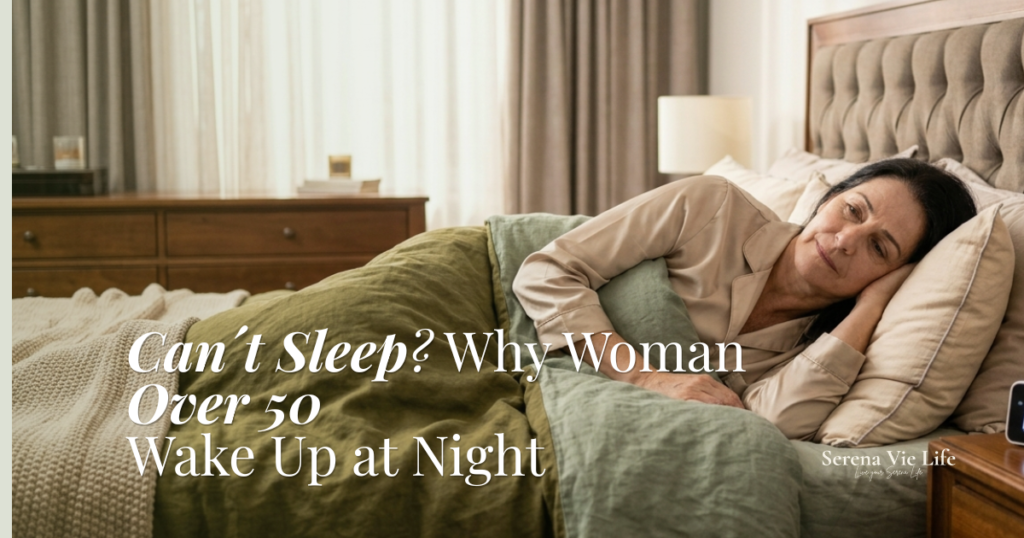
It’s 3:17am. You’re wide awake, staring at the ceiling, mentally running through your to-do list while your body feels wired and exhausted at the same time. This wasn’t a problem five years ago. What happened?
If you’re wondering why women over 50 wake up at night, you’re not alone. If this sounds like your nights lately, you’re not alone — and you’re not imagining it. Sleep changes significantly after 50, and for women especially, the disruptions can feel almost cruel: you’re more tired than ever during the day, but you can’t stay asleep at night.
The good news is that there’s usually a real reason this happens. Understanding it is the first step to doing something about it.
Why Women Over 50 Wake Up at Night: Your Sleep Has Changed
Sleep isn’t a fixed, unchanging process. It shifts throughout your life — and the years around and after menopause bring some of the most significant changes most women will ever experience in how they sleep.
Several things are happening at once:
1. Hormonal Changes Disrupt Your Sleep Architecture
Estrogen and progesterone aren’t just reproductive hormones. They play an active role in regulating sleep. Progesterone, in particular, has a natural calming, sleep-promoting effect. When levels drop during perimenopause and menopause, many women find they feel more anxious at night, struggle to fall asleep, and wake more easily.
Estrogen affects your body’s ability to regulate temperature — which is why hot flashes and night sweats are so common and so disruptive. Even minor temperature fluctuations can pull you out of deep sleep, and once you’re awake and overheated, falling back asleep can feel impossible. If night sweats are a big part of your nights, the right best pillows for night sweats can help your body cool down faster so you fall back asleep sooner.
2. Your Circadian Rhythm Shifts
As we age, our internal clock — the circadian rhythm — tends to shift earlier. You may find yourself feeling sleepy earlier in the evening but waking up earlier than you’d like in the morning. This is called a “phase advance,” and it’s a normal part of aging, but it can feel disorienting if your schedule hasn’t shifted with it.
On top of that, older adults produce less melatonin — the hormone that signals to your body that it’s time to sleep. Less melatonin means weaker sleep signals, lighter sleep overall, and more vulnerability to waking from noise, light, or even minor discomfort.
3. Sleep Becomes Lighter and More Fragmented
Deep, restorative sleep (called slow-wave sleep) naturally decreases with age. By the time most women reach their 50s, they spend significantly less time in this deep stage than they did at 30 or 40. This means sleep feels less satisfying, even when the total hours are technically “enough.”
You’re also more likely to spend time in lighter sleep stages, which makes you more susceptible to waking — from a sound, a change in temperature, a dream, or apparently nothing at all.
4. Stress and Anxiety Play a Bigger Role
The 3am wake-up is often not random. Many women describe waking up and immediately feeling a wave of anxiety — worry about health, finances, relationships, aging parents, adult children. The mind that was quiet during the day suddenly becomes loud in the middle of the night.
This happens partly because cortisol — your stress hormone — naturally starts rising in the early morning hours to prepare your body for the day. After 50, this cortisol curve can shift and become more pronounced, waking you earlier than you’d like and making it hard to settle back down.
Other Factors That Make Sleep Worse After 50
Hormones are a major piece of the puzzle, but they’re not the only one. Several other factors commonly disrupt sleep in this season of life:
Sleep apnea — More common in women after menopause than most people realize. If you snore, wake up with a dry mouth or headache, or feel exhausted despite a full night’s sleep, it’s worth getting evaluated. Many women with sleep apnea go undiagnosed for years.
Restless legs syndrome (RLS) — An uncomfortable urge to move your legs, especially at night. More prevalent in women and tends to worsen with age.
Pain and physical discomfort — Joint pain, back pain, and other physical issues that weren’t present or as intense at 40 can significantly interrupt sleep.
Medications — Some blood pressure medications, antidepressants, and other commonly prescribed drugs can affect sleep quality. If your sleep changed around the same time you started a new medication, it’s worth mentioning to your doctor.
Alcohol — Even a glass of wine in the evening can fragment sleep significantly. Alcohol helps you fall asleep faster but disrupts the second half of the night, causing wakefulness and lighter sleep.
Screen time and light exposure — Blue light from phones, tablets, and TVs suppresses melatonin production. After 50, when your melatonin levels are already lower, this matters even more.
What 3am Wakefulness Feels Like When Women Over 50 Wake Up at Night
If you’ve experienced it, you know: waking at 3am feels different from just being a light sleeper. There’s often a physical component — heart racing slightly, a feeling of being alert rather than groggy, sometimes warmth or a flush. The mind engages quickly, and before you know it, you’re fully awake and thinking.
This pattern — falling asleep fine but waking in the early morning hours and struggling to return to sleep — is called sleep maintenance insomnia, and it’s one of the most common sleep complaints among women in their 50s and 60s.
It’s worth naming, because it helps to know: this is a recognizable pattern with recognizable causes. It is not a character flaw. It is not you being anxious for no reason. It is your biology doing what biology does — and there are real, practical things that can help.
When to Talk to a Doctor
Understanding exactly why women over 50 wake up at night helps doctors identify the right treatment. Not all sleep problems after 50 require a doctor’s visit, but some do. Consider making an appointment if:
- You’ve had significant sleep disruption for more than a few weeks
- You suspect you might have sleep apnea (snoring, morning headaches, daytime exhaustion despite sleeping)
- Your sleep disruption is affecting your mood, concentration, or daily functioning
- You’re relying on sleep aids regularly just to get through the night
- Your sleep changed alongside other symptoms (mood changes, new medications, significant weight changes)
You Deserve to Sleep Well
There’s a pervasive cultural message that poor sleep is just something women accept as they get older — part of the package of aging. This is not true, and it’s not helpful.
Yes, sleep changes with age. But disrupted, unrestorative sleep is not inevitable, and it’s not something you should simply push through. Chronic poor sleep affects everything: your immune function, your mood, your cognitive clarity, your cardiovascular health, your weight, your skin.
Understanding why women over 50 wake up at night — and addressing those causes — is one of the most powerful things you can do for your health. Taking your sleep seriously is not a luxury. It’s one of the most important things you can do for your health after 50.
In our next article, we look at what actually works. If you now understand why women over 50 wake up at night, the next step is finding real solutions. Read: Best Natural Sleep Aids for Women Over 50 — the habits, supplements, and tools that make a real difference for women in this season of life. Not gimmicks. Not things that help for one night and stop working. Things with real evidence behind them.
FAQ
Is it normal to wake up every night after 50?
It’s common, but “common” doesn’t mean you have to accept it. One of the most common questions we get is: why women over 50 wake up at night so frequently? Waking briefly is normal, but waking fully and struggling to fall back asleep is a sign something is disrupting your sleep — and that’s worth addressing.
Why do I wake up at exactly 3am?
It’s not exactly 3am for everyone, but early-morning waking (between 2am and 5am) is very common. This is when cortisol begins its natural morning rise and when sleep is lightest. Any disruption — a hot flash, a sound, a thought — is more likely to wake you fully during this window.
Could my sleep problems be a sign of depression?
Yes, possibly. Early-morning waking is actually one of the classic symptoms of depression. If waking at 3am comes with persistent low mood, loss of interest in things you normally enjoy, or hopelessness, it’s worth talking to a doctor or mental health professional.
Will my sleep ever go back to normal?
Sleep after menopause is different from what it was at 35 — but “different” doesn’t have to mean “worse.” Many women find that with the right adjustments, their sleep improves significantly. It takes attention and sometimes experimentation, but restorative sleep is absolutely achievable.
Is it okay to take melatonin every night?
Melatonin is generally considered safe for short-term use, and low doses (0.5–1mg) are often more effective than the high doses sold in most stores. That said, it works best for circadian rhythm issues (like jet lag or shifting your sleep schedule) rather than middle-of-the-night waking. It’s not a long-term solution on its own.
Sources: National Institute on Aging — “A Good Night’s Sleep”; Santoro N. et al., “Menopausal Symptoms and Their Management,” Endocrinology and Metabolism Clinics of North America, 2015 (PubMed PMID: 26316239); Jehan S. et al., “Sleep Disorders in Women,” Journal of Sleep Medicine and Disorders, 2017 (PMC5323065); Mayo Clinic — “Insomnia”; Kravitz HM et al., “Sleep Difficulty in Women at Midlife,” Menopause, 2003 (PubMed PMID: 12851517); Burgess HJ et al., “Circadian Rhythm Sleep Disorders,” Primary Care: Clinics in Office Practice, 2005.